If you’ve ever searched TPT for a resource you know you sell — only to scroll through page after page without finding your own product — you’re not alone.
It’s frustrating.
Especially when you know your resource is exactly what a teacher is looking for.
But not showing up where you expect to in TPT search doesn’t automatically mean your product is bad, your store is failing, or that you need to cram more keywords into your description.
There are a few different reasons a product might not be getting the search visibility you want.
And the first step is figuring out what the problem actually is.
First: TPT search isn’t the same as Google search
When someone searches Google, they might be looking for information, ideas, inspiration, a particular website, or a product.
On TPT, the person searching is usually much closer to making a decision.
They might be searching for:
- a Year 4 fractions worksheet
- beginning sounds activities
- Christmas reading comprehension
- a Spanish classroom decor bundle
TPT also allows buyers to refine their searches using filters such as grade, subject, price, standards and resource type.
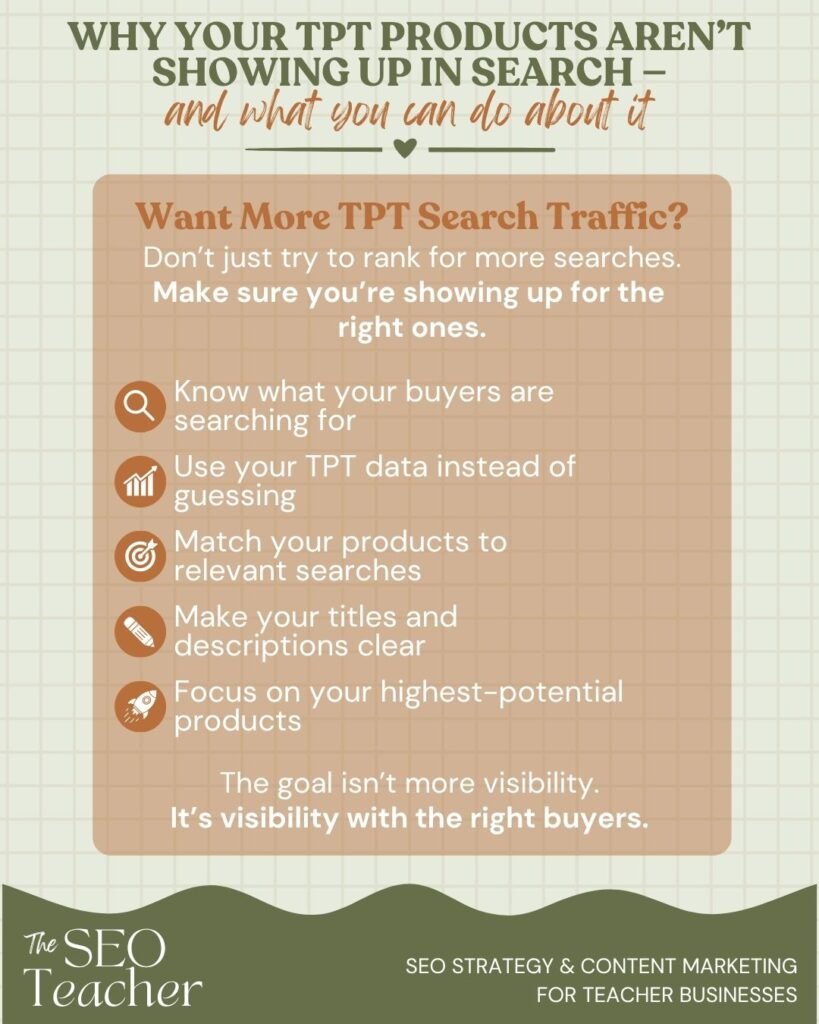
That means your product needs to make it very clear what it is, who it’s for and what problem it solves.
If those things aren’t clear, you’re making it harder for the right buyer to find you.
1. Your product might not match the search you’re targeting
This is one of the biggest things I look at when reviewing TPT products.
Imagine you’ve created a resource called:
Fun Spring Activity Pack
It might be a fantastic resource.
But what would a teacher actually search for?
Maybe:
- spring math activities
- spring literacy activities
- spring worksheets
- spring centers
- spring writing activities
- spring activities for kindergarten
“Fun Spring Activity Pack” tells me very little about what’s inside.
The problem isn’t necessarily that the product doesn’t contain useful keywords.
The problem is that the main idea isn’t clear enough.
Ask yourself:
If I were a teacher looking for this resource, what would I type into the TPT search bar?
Start there.
Don’t start with what you want your product to rank for.
Start with what your buyer is actually looking for.
2. Your title might be too creative
This is a common problem with teacher-created resources.
And I completely understand why it happens.
You’ve spent time making a beautiful resource, so you want the title to sound interesting.
But there’s a difference between a title that’s appealing to a buyer after they’ve found it and a title that helps them find it in the first place.
For example:
“Roll Into Learning!”
sounds fun.
But:
“Multiplication Roll & Cover Game | 3rd Grade Math”
immediately tells me what the resource is.
You don’t have to remove all personality from your product titles.
Instead, try putting the searchable description first and the creative name second.
For example:
3rd Grade Multiplication Game | Roll Into Learning
Now both the teacher and the searcher have useful information.
3. You’re targeting a search that’s too broad
This is another big one.
Let’s say you sell an art resource for middle school students.
You might think:
“I want to rank for art.”
Fair enough.
But “art” is enormous.
There are thousands of possible resources and dozens of different reasons someone might search for the word.
A more specific search such as:
middle school perspective art plans
tells us much more about what the buyer wants.
And that’s where being specific can help.
Instead of asking:
“What is the biggest keyword I can use?”
ask:
“What is the most relevant search for this particular product?”
Those are two very different questions.
4. You’re using keywords that don’t match buyer intent
This one is easy to miss.
A keyword can look relevant on the surface but still attract the wrong person.
For example, imagine you sell a paid set of elementary science lessons.
You discover that people are searching for:
free elementary science lesson plans
It might be tempting to add that phrase everywhere because people are searching for it.
But if your product isn’t free, you’re unlikely to satisfy that search.
You may get visibility without getting the right clicks — or you may attract people who quickly realise your product isn’t what they’re looking for.
More traffic isn’t always better traffic.
The goal is to attract teachers who are actually looking for what you sell.
5. Your description isn’t helping clarify the product
Once someone finds your product, your description has another job:
help them decide whether it’s right for them.
But your description can also help reinforce what your resource is about.
Let’s compare these:
❌ Vague
This fun and engaging resource is perfect for helping students develop their skills. Students will love these activities!
It sounds positive.
But it doesn’t tell me much.
✅ Specific
This set of 12 printable multiplication activities is designed for 3rd grade students practising multiplication facts from 2–12. Use the activities for independent practice, math centers, early finishers or review.
Now I know:
- what it is
- who it’s for
- what skill it teaches
- how many activities are included
- how it can be used
That’s much more useful.
Your description doesn’t need to be a giant block of keywords.
It needs to communicate clearly.
6. You’re trying to optimise every product at once
If you have 50, 100 or 500 products in your store, you could spend months trying to improve every listing.
I wouldn’t recommend starting there.
Instead, look for your highest-potential products.
Start with products that already show some evidence of demand.
For example:
- products getting views but not many sales
- products with good conversion rates
- products connected to searches that are already bringing people to your store
- products that solve a specific, clearly identifiable problem
- products that are part of a strong product range
You don’t need to overhaul your entire store tomorrow.
You need to work out where your best opportunities are.
7. You’re guessing instead of looking at your TPT data
This is where things get much more interesting.
If you’re a Premium Seller, TPT’s Search Analytics can show you the search terms buyers have used to find your products, along with visits, conversions, earnings and the products they clicked.
That’s incredibly useful because you’re no longer asking:
“What do I think people are searching for?”
You’re asking:
“What are people actually searching for when they find my products?”
For example, you might discover that your products are being found through:
- “middle school math sub plans”
- “measuring shapes”
- “math art”
- “addition to ten lesson”
Those searches can tell you a lot about what buyers associate with your products.
And sometimes the results are surprising.
You may discover that a product you thought was mainly about one topic is actually getting found through a different search.
That’s information worth paying attention to.
TPT’s Search Analytics can also be viewed for an individual product, rather than only looking at your store as a whole.
8. You’re choosing keywords based only on competition
There’s another mistake I see often:
“There are lots of people searching for this, so I should target it.”
Not necessarily.
A popular search can also have a huge amount of competition.
TPT’s newer Keyword Finder gives sellers information about search volume, related keywords, the number of available resources and an Opportunity Score. The score considers search volume alongside the number of resources available for that keyword.
That’s much more useful than simply choosing the biggest number.
You’re looking for the intersection of:
People are searching for it
+
It actually describes my product
+
There’s a realistic opportunity for my resource
That’s where your strategy starts to become much more useful.
9. Your product might be visible — but not for the searches you care about
This is an important distinction.
A product can get TPT search traffic without necessarily getting traffic from the best searches for that product.
And this is why I wouldn’t judge a product based on one metric alone.
For example, you might see:
Lots of views + very few sales
and immediately assume:
“This product needs better SEO.”
Maybe.
But it could also mean:
- the search intent doesn’t match the product
- the title attracts the wrong audience
- the price isn’t competitive
- the preview isn’t convincing
- the product isn’t quite what the buyer expected
- the resource is appearing for broad searches rather than highly relevant ones
TPT itself recommends looking at factors such as the title, description, grade tags and price when investigating products with lower conversion rates.
In other words:
Search visibility is only part of the picture.
So, what should you actually do?
If you think your TPT products aren’t showing up in search, don’t immediately start rewriting everything.
Try this instead.
Step 1: Pick 3–5 important products
Choose products that:
- already sell
- get views
- fit an important part of your store
- have growth potential
- or are products you really want to promote
Don’t start with your entire catalogue.
Step 2: Look at what people are actually searching
If you have access to TPT Search Analytics, look at the search terms associated with those products.
Look for:
Which searches are bringing people in?
Which searches are converting?
Which searches are getting visits but no sales?
Are there specific phrases that repeatedly appear across your products?
This gives you a starting point based on evidence rather than guesses.
Step 3: Check whether your product actually matches those searches
This is the part people often skip.
If you find a promising keyword, ask:
Would a teacher searching this phrase be happy to land on my product?
If the answer is yes, great.
If the answer is “sort of,” that’s a sign to investigate further.
If the answer is no, don’t force the keyword into your listing just because it gets searched.
Step 4: Look at your title
Can someone immediately tell:
- what the resource is?
- what subject it covers?
- who it’s for?
- what skill/topic it addresses?
If not, your title may need work.
Step 5: Look at your description
Make sure the important information is easy to find.
Think about:
- What is included?
- Who is it for?
- What will students practise?
- How could a teacher use it?
- What makes this resource useful?
Write for a teacher first.
Then make sure the language naturally reflects the searches you’re targeting.
Step 6: Don’t forget the rest of your listing
Search isn’t the only reason someone buys.
Once a teacher finds your resource, they still need to decide:
“Is this worth buying?”
That means your:
- preview
- product description
- price
- resource quality
- reviews
- images
- and overall presentation
all matter.
Getting someone to your product page is only half the job.
One final thing: don’t panic if you can’t find your product
TPT search results can be filtered and sorted in different ways, including relevance, price, rating and recency.
So searching for your own product once and not seeing it near the top doesn’t necessarily tell you everything you need to know.
And TPT’s Search Analytics doesn’t provide impressions or ranking data, so it can’t tell you exactly how often your product appeared in search or exactly where it ranked.
That’s why I prefer looking at the bigger picture:
What are people searching for?
Which products are they clicking?
Which searches are leading to sales?
Where are the strongest opportunities?
That’s much more useful than obsessively searching your own product and counting how many pages you have to scroll through.
Your TPT search strategy doesn’t need to be complicated
You don’t need to become an SEO expert.
You don’t need to rewrite 200 product descriptions.
And you definitely don’t need to stuff every keyword you can think of into your listings.
Start with a few important products.
Look at the data.
Find the searches that matter.
Make sure your products clearly match those searches.
Then improve the listings where you see the strongest opportunity.
That’s a much better starting point than changing everything and hoping something works.
And remember: the goal isn’t simply to show up in more searches. It’s to show up in the right searches.
Want help figuring out where your TPT store’s biggest opportunities are?
That’s exactly what I look at in The TPT Store SEO & Growth Review.
I’ll look at your store, your products and the search data available to you to identify:
- which products are worth prioritising
- what buyers are actually searching for
- where your strongest search opportunities are
- which products may need attention
- keyword and content themes worth exploring
- and what I’d tackle first
You don’t need a blog or a separate website.
Just a TPT store with room to grow.
[Learn more about The TPT Store SEO & Growth Review →]
A note for the reader
SEO results can’t be guaranteed. TPT’s search algorithms, competition, buyer behaviour and other marketplace factors can all affect visibility, traffic and sales. The best approach is to use the data available to you to identify and prioritise the strongest opportunities.