
You have a website, you’ve created great resources, and you’ve even written some blog posts. So why aren’t teachers finding you through Google? Here are some of the common SEO issues that could be holding your website back.
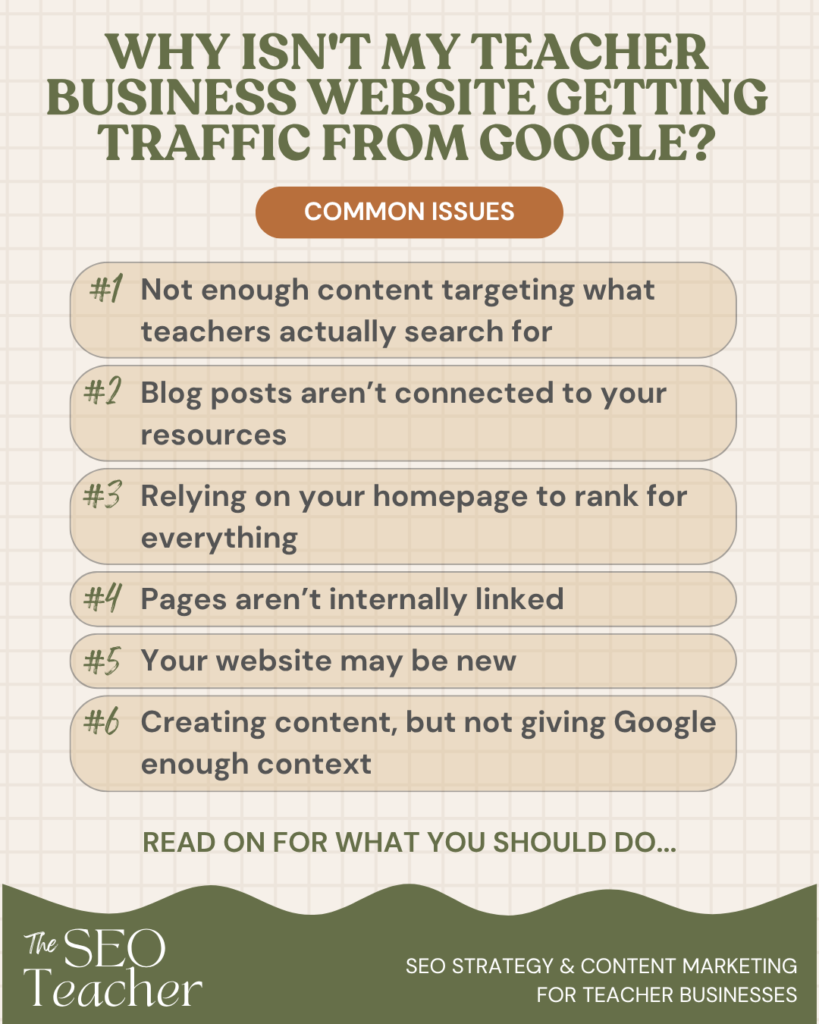
1. You’re targeting keywords that teachers aren’t searching for
One of the biggest SEO mistakes is choosing keywords based on what you would search for rather than what your potential customers actually type into Google.
For example, you might describe one of your resources as a:
“Year 3 Fraction Learning Pack”
But a teacher might search for:
- Year 3 fractions worksheets
- fraction activities for Year 3
- teaching fractions Year 3
- fraction games for kids
- equivalent fractions activities
The language you use on your website matters because it helps Google understand what your page is relevant to.
This doesn’t mean you need to turn every page into a collection of keywords. In fact, stuffing keywords into your content can make it harder to read and isn’t a good SEO strategy.
Instead, start by thinking about the problems your ideal customer is trying to solve.
What would they search for if they didn’t know your product existed?
Those searches can reveal much more useful keyword opportunities.
2. Your website doesn’t have enough content around your products
Your product pages are important, but they may not be enough to attract a significant amount of organic search traffic.
Think about the difference between these two searches:
“Year 2 addition worksheets”
and
“How do I teach addition to Year 2 students?”
The first person may be looking for a resource to purchase.
The second person is looking for information.
A helpful blog post could answer that second search and introduce that teacher to your website.
This is one of the biggest opportunities for teacher businesses.
Your blog doesn’t need to be a collection of random articles. It can become a bridge between what teachers are searching for and the resources you sell.
For example, if you sell resources about persuasive writing, you could create content around:
- How to teach persuasive writing
- Persuasive writing topics for primary students
- How to structure a persuasive text
- Persuasive writing activities for Year 5
- Common persuasive writing mistakes students make
Each useful article creates another opportunity for your website to appear in Google.
3. You’re relying entirely on your TPT store
Your TPT store can be an excellent place to sell your resources.
But it shouldn’t have to be your entire marketing strategy.
When someone searches Google, they aren’t necessarily looking for your TPT store. They might be searching for an idea, activity, teaching strategy or solution to a classroom problem.
Your website gives you somewhere to meet those searches.
This is where your TPT store and website can work together.
A blog post can attract a teacher through Google. Your internal links can then guide them towards a relevant resource. Your resource pages can send them to TPT when they’re ready to buy.
Instead of relying on a single platform to bring you customers, you’re building your own pathway:
Google → Website → Helpful content → Relevant resource → TPT
That’s a much stronger long-term strategy than simply hoping teachers find your TPT products.
4. Your pages aren’t connected to each other
Google doesn’t just look at individual pages in isolation. The structure of your website helps search engines understand how your content relates to each other.
Imagine you’ve written five excellent blog posts about reading comprehension.
If none of those posts link to your reading comprehension resources, and your resource pages don’t link back to relevant blog content, you’re missing an opportunity.
Internal links can help you create connections such as:
Blog post → related blog post → resource page → TPT
For example, a blog post about teaching inferencing could link to another article about inferencing activities and then to your relevant inferencing resource.
These connections make your website more useful for visitors and help search engines understand the relationships between your pages.
You don’t need hundreds of links.
Start by asking:
“What would a teacher who is reading this page want to look at next?”
Then give them an obvious next step.
5. You’re writing for Google instead of teachers
SEO content still needs to be good content.
It’s tempting to look at a keyword and write an article around it simply because you want to rank for that phrase.
But if the resulting article is repetitive, awkward or doesn’t actually answer the question, it isn’t going to provide a great experience for your audience.
Your advantage as a teacher business owner is that you understand teachers.
Use that.
Write the way you would explain something to another teacher.
Answer the questions they actually have.
Give practical examples.
Share your expertise.
Use natural language.
Then use SEO to make that useful content easier for the right people to discover.
The goal isn’t to write for Google.
The goal is to create something genuinely useful for your audience that Google can understand.
6. Your website is still relatively new
This one can be difficult to accept.
You can do everything correctly and still not see significant organic traffic immediately.
SEO is not usually an overnight strategy.
A newer website has had less time to build up content, links, visibility and authority. Google also needs time to crawl and index new pages and understand where they fit within search results.
That’s why I wouldn’t judge an SEO strategy based on what happens in the first few weeks.
Instead, look for signs of progress.
Are more of your pages being indexed?
Are impressions increasing?
Are you appearing for more search queries?
Are some pages gradually moving closer to the first page?
Those smaller improvements can be much more meaningful than expecting hundreds of visitors immediately.
7. You’re not giving Google enough reasons to understand your expertise
Your website should make it reasonably clear what you know, who you help and what topics you specialise in.
If your site contains a handful of unrelated product pages but very little supporting content, Google has less information to work with.
But imagine a website that consistently publishes useful content about:
- phonics
- early reading
- reading comprehension
- literacy instruction
- classroom literacy activities
That website is developing a much clearer topical focus.
This is where consistent, relevant content can become valuable.
You don’t need to publish every day.
One genuinely useful article a week can be far more valuable than publishing five rushed posts that don’t serve your audience.
So, what should you do?
If your teacher business website isn’t getting much Google traffic, don’t immediately assume you need to redesign the entire website or publish dozens of blog posts.
Start with the basics.
Look at your existing website
Ask:
1. What searches could each important page appear for?
If you can’t identify a relevant search, the page may need clearer positioning.
2. Are you using the language your customers actually use?
Look beyond the terminology you use internally.
3. Do you have useful content beyond your product pages?
Think about the questions and problems your ideal customers search for.
4. Are your pages linked together?
Make it easy for visitors — and search engines — to move between related content.
5. Are you consistently creating useful content?
You don’t need to publish constantly. You need to publish with a purpose.
6. Are you giving it enough time?
SEO is a long-term strategy. Give your content time to be discovered, indexed and evaluated.
Your website doesn’t just need more traffic. It needs the right traffic.
It’s easy to get caught up in visitor numbers.
But 1,000 visitors who have no interest in your resources aren’t necessarily more valuable than 50 teachers who are actively looking for exactly what you offer.
The goal of SEO for your teacher business isn’t simply to get more people to your website.
It’s to help the right teachers discover you when they’re already looking for something you can help them with.
That’s why SEO is more than adding keywords to your website.
It’s about understanding what your audience searches for, creating useful content around those searches and building a website that connects that content to what you offer.
And once those pieces start working together, your website can become more than an online brochure.
It can become a way for teachers to discover your expertise, find your resources and eventually become customers — without you having to rely entirely on social media or TPT search.
Ready to turn your website into a source of traffic?
If your teacher business website isn’t getting much traffic from Google, it doesn’t necessarily mean you need to publish more content or spend hours learning SEO.
Often, the problem is simply that your website isn’t yet aligned with what your ideal customers are searching for — or Google doesn’t have enough information to understand when your content should appear.
Start with one small step. Look at your website from your ideal customer’s perspective and ask:
What would they type into Google before they ever knew my business existed?
Those searches can become the starting point for your SEO strategy.
And if you’re not sure where to start, that’s exactly what I help teacher businesses with.
Want to know what your website should be doing next?
The Growth Roadmap™ is a personalised SEO strategy designed specifically for teacher businesses. I’ll identify your biggest opportunities across keywords, website content and blog content, then give you a clear roadmap of what to focus on next.
You don’t need to become an SEO expert. You just need to know which opportunities are worth your time.