If you’ve been selling on Teachers Pay Teachers for a while, there’s a good chance your store has grown into something much bigger than you ever intended.
Maybe you have 100 products. Maybe 500. Maybe you’ve lost count.
And when you start thinking about TPT SEO, it’s easy to think you need to go through every single product and optimise every title, description and preview.
You don’t.
In fact, trying to optimise your entire TPT store at once is probably not the best use of your time.
Good TPT SEO isn’t about changing everything. It’s about figuring out what is worth changing first.
Here’s how I would approach it.
1. Start with the data you already have
Before changing a product listing, take a look at what’s already happening in your store.
If you’re a Premium TPT seller, Search Analytics can show you the search terms that have brought buyers to your resources, along with visits, conversions and earnings associated with those searches.
That’s useful because you’re not simply guessing what teachers might search for. You’re looking at searches that have actually brought people to your store.
But don’t make the mistake of simply looking for the search terms with the most activity.
A search term is only useful if it is relevant to your products and your buyers.
For example, imagine you sell a set of differentiated reading activities.
A search around differentiated reading activities might be highly relevant.
A much broader search around reading activities might have considerably more activity, but that doesn’t automatically make it a better opportunity.
You want to find the searches that connect your products with the people who are most likely to want them.
2. Look at how your products are actually performing
Your search data is only half of the picture.
Next, look at your product-level data.
You’re looking for clues about what happens after someone finds a product.
There are a few patterns worth paying attention to.
High views + good conversion
This is a product that is already attracting attention and turning some of that attention into sales.
That’s a good sign.
Rather than completely rewriting the listing, you might ask:
Could I get this product in front of more of the right buyers?
This could be a good visibility opportunity.
High views + low conversion
This is different.
People are finding the product, but relatively few are buying it.
That doesn’t necessarily mean the SEO is bad.
It may mean the listing itself needs attention.
Look at things like:
- Is the title clear?
- Is it immediately obvious who the resource is for?
- Does the description explain what the buyer is getting?
- Do the opening lines make the resource sound useful?
- Does the preview give buyers enough information?
- Is the value of the resource clear?
This is where more keywords aren’t necessarily the answer.
Low views + good conversion
This is an interesting one.
If relatively few people are finding a product but the people who do find it are buying it, you may have a visibility opportunity.
The product appears to have something buyers want.
The question becomes:
How can I help more relevant buyers find it?
Low views + low conversion
These products probably shouldn’t be your first SEO project.
There simply isn’t as much evidence that improving visibility will solve the problem.
There could be an issue with the product, the positioning, the listing or the demand for the resource — or there may simply not be enough data yet to know.
That doesn’t mean you should never work on these products.
It just means they probably don’t belong at the top of your list.
3. Look for the overlap
This is where things get more interesting.
Your strongest SEO opportunities often appear where three things overlap:
People are searching for it
+
You have a product that genuinely matches the search
+
The product shows evidence of performing well when people find it
That’s much more useful than simply finding a popular keyword and trying to squeeze it into a product listing.
Your data might reveal something like this:
Teachers are searching for a particular type of resource → you already have a product that matches → that product converts reasonably well → but it isn’t attracting much traffic.
That’s a product worth investigating.
Or perhaps:
A product gets plenty of views → but very few sales → the search traffic is there → something about the listing or offer may need attention.
Those are two completely different problems.
And they require two completely different approaches.
4. Don’t try to optimise 300 products at once
This is where I think many TPT sellers make SEO harder than it needs to be.
If you have hundreds of products, you could spend months working your way through them.
And by the time you’ve finished, you may have no idea which changes actually made a difference.
Instead, choose a small group of priority products.
Three to five is a perfectly reasonable place to start.
For each one, you can properly look at:
- its current performance
- the searches bringing people to your store
- the product title
- the description
- the preview
- the audience
- the resource type
- the buyer’s likely need
- relevant search themes
Then you can make a small number of purposeful changes.
This gives you something much more valuable than a completely rewritten store:
information about what actually works for your business.
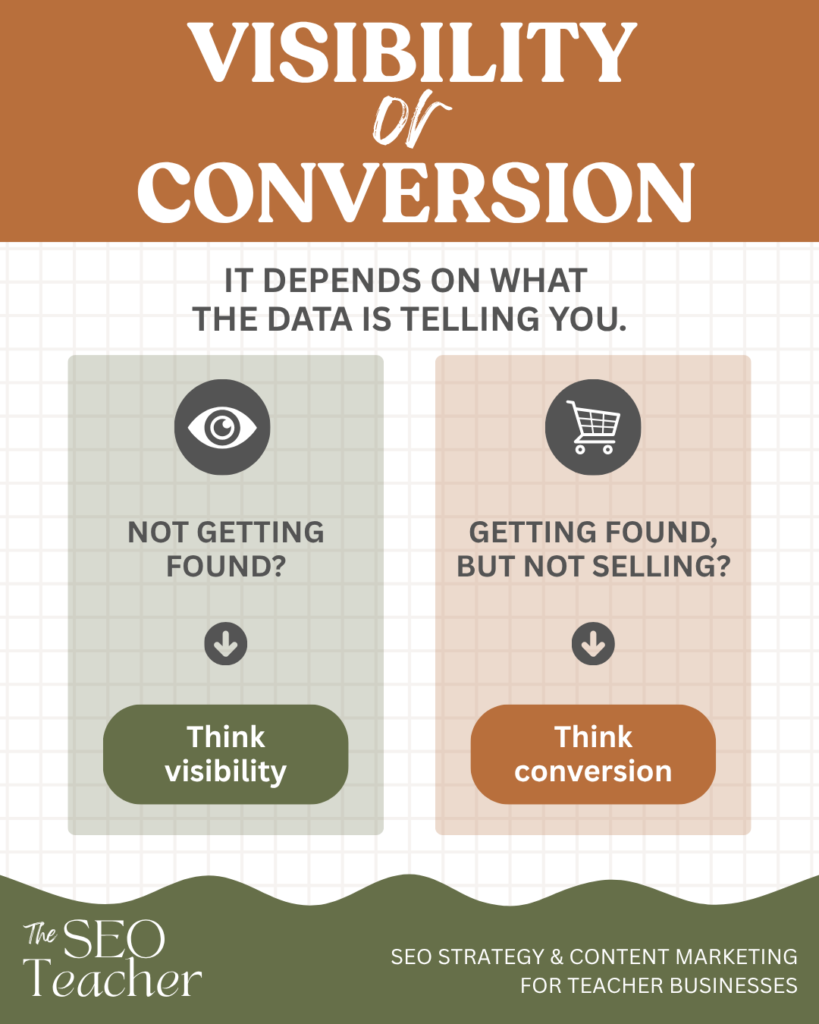
5. Work out whether you have a visibility or conversion problem
This distinction is important.
If people aren’t finding your product
Think visibility.
Look at:
- relevant search themes
- wording in your title
- how clearly the resource is positioned
- whether the audience and use case are obvious
- whether the product is aligned with searches your potential buyers are actually using
If people are finding your product but aren’t buying
Think conversion.
Look at:
- the clarity of the listing
- the opening description
- the preview
- what the buyer is actually getting
- whether the resource solves a clear problem
- whether the product’s value is obvious
And don’t automatically respond to poor conversion by adding more keywords.
If plenty of people are already finding the product, getting more people to find it isn’t necessarily the problem.
6. Use your search data to guide your wording — not dictate it
Once you’ve identified relevant search themes, look at how naturally they fit your products.
For example, if your search data suggests that buyers are looking for:
differentiated reading activities
and you have a product that genuinely is a differentiated reading activity, that’s useful information.
You can check whether your listing makes that clear.
But you don’t need to repeat differentiated reading activities ten times throughout the description.
Your goal is to make the product clear and relevant, not to make the listing sound like it was written for a search algorithm.
If a search term doesn’t accurately describe your resource, don’t use it just because it has a lot of search activity.
Relevance comes first.
7. Make your changes, then give them time
This is the part that’s easy to overlook.
You make some changes to your listing.
A week later, you check your sales.
Nothing obvious has happened.
So you assume the changes didn’t work.
That’s not necessarily what the data is telling you.
TPT traffic and sales can fluctuate, and products with relatively low traffic can take quite a while to generate enough data for a meaningful comparison.
Instead, keep a record of:
- your starting views
- conversion rate
- earnings
- units sold
- the search themes you were targeting
- exactly what you changed
- the date you made the changes
Then give the changes some time.
Don’t keep changing the same listing every few days.
If you change the title on Monday, the description on Thursday and the preview the following Tuesday, it becomes much harder to know what you’re actually learning from the results.
Make purposeful changes, record them, and let the listing gather some data.
8. Then move on to the next opportunity
Once you’ve worked through your first small group of products, you can repeat the process.
Look at what you’ve learned.
Maybe you discovered that a particular type of product is consistently converting well.
Maybe you found a search theme that’s particularly relevant to your store.
Maybe you discovered that several products get plenty of traffic but struggle to convert.
Maybe a product you thought was a great SEO opportunity turns out not to be worth your time.
All of that is useful information.
You can use it to choose your next group of products.
Over time, you’re building a much more useful SEO process:
Find → prioritise → improve → measure → learn → repeat.
Rather than:
Change everything → hope → wonder what happened.
You don’t need to optimise your whole store
SEO can feel like a huge job when you look at your entire TPT store.
But it doesn’t have to be.
You don’t need to start with your oldest product.
You don’t need to work alphabetically.
And you definitely don’t need to rewrite hundreds of listings just because you think you’re “supposed to” be doing SEO.
- Start where the evidence gives you a reason to act.
- Look for the overlap between search activity, product relevance and product performance.
- Choose a small number of products.
- Make thoughtful changes.
- Give them time.
- Then use what you learn to decide what deserves your attention next.
Good TPT SEO isn’t about doing more. It’s about knowing what is worth doing first.
Want help figuring out where to start?
If you’re not sure which products in your TPT store deserve your attention first, my TPT SEO & Growth Review looks at your search and product data to identify opportunities and help you prioritise your next steps.
Learn more about TPT SEO & Growth Reviews