If you’re trying to decide between TPT Basic and Exclusive, there’s one word that seems to be causing a lot of confusion: exclusivity.
What does being an Exclusive Seller actually prevent you from doing?
Can you still have your own website? Can you have an email list? Can you sell courses? What about clipart? Can you promote your TPT resources on Instagram or Pinterest?
The short answer is that being an Exclusive Seller does not mean you have to run your entire business through TPT.
It does, however, mean that certain digital educational resources need to be sold exclusively through TPT.
That distinction is important.
This post is based on TPT’s current seller rules as published in October 2026. If you’re making a decision about your membership, always check TPT’s current terms and FAQs as well.
What does TPT actually mean by “Exclusive”?
Under TPT’s new Exclusive Seller membership, you agree to sell your digital educational resources exclusively on TPT.
You can still promote your store and resources on other platforms, and you can maintain your own website or storefront.
The important part is where the transaction happens.
If a resource falls under TPT’s digital educational resource category and you’re an Exclusive Seller, the sale needs to be routed through TPT.
So, for example, having a page on your website that says:
“Find my resources on TPT”
is very different from having a checkout on your website where someone can purchase that same qualifying digital educational resource directly from you.
Your website can still exist. Your business can still exist. Your marketing can still exist.
The sale of the qualifying digital resource just needs to happen through TPT.
What can an Exclusive Seller sell outside TPT?
This is where things get more interesting.
TPT specifically lists several types of products that Exclusive Sellers can sell outside their TPT store.
These include:
- Digital products unrelated to education or teaching, such as clipart and fonts
- Physical products
- Courses and professional development
- Boom Cards
- Kindle books
TPT also says Exclusive Sellers can offer free digital educational resources both on and off TPT.
There are some conditions around this, though. For example, you can’t charge for a resource on TPT if you’re offering that same resource for free elsewhere.
So “exclusive” doesn’t mean you have to stop doing anything outside TPT.
It means you need to understand which products are covered by the exclusivity requirement and which aren’t.
What can’t an Exclusive Seller sell elsewhere?
The biggest restriction is on digital educational resources.
TPT’s current guidance says Exclusive Sellers cannot sell qualifying digital educational resources outside TPT.
That includes selling the same resource through your own website or another marketplace.
TPT also specifically lists the following as not permitted to be sold outside TPT by an Exclusive Seller:
- Digital educational resources
- Memberships or subscriptions that include access to your digital educational resources
- Digital educational resource licences
This is why the decision between Basic and Exclusive isn’t simply about the payout percentage.
If you already sell your educational resources through multiple marketplaces, or you’ve been planning to build your own digital-resource shop, exclusivity could have a much bigger impact on your business than the difference in payout.
Can an Exclusive Seller still have a website?
Yes.
This is one of the points that seems to be getting lost in some of the discussion around the new membership.
TPT specifically says Exclusive Sellers can maintain their own website or storefront.
The difference is what you’re using that website to do.
Your website could be used to:
- Tell people about your business
- Showcase your work
- Link visitors to your TPT store
- Publish blog content
- Build your brand
- Offer free resources
- Collect email subscribers, where appropriate
- Promote courses or professional development
- Sell physical products
- Sell permitted non-educational digital products such as clipart or fonts
What you can’t use it for as an Exclusive Seller is selling your qualifying digital educational resources directly to customers.
That means your website doesn’t have to disappear just because you choose Exclusive.
In fact, I would argue that having your own website can still be a very worthwhile part of your business.
What about social media?
You can still promote your TPT store and resources on other platforms.
That includes the kinds of places many teacher-sellers are already using to build an audience:
- YouTube
- Your website
- Your blog
The important distinction is between marketing a TPT resource and selling that qualifying resource somewhere else.
For an Exclusive Seller, you can use other platforms to help people discover your resource, but the transaction needs to happen through TPT.
That’s actually an important distinction to keep in mind when thinking about your long-term business strategy.
You don’t have to choose between:
TPT OR having your own online presence.
You can have both.
The question is what role each one plays.
What about an email list?
This is another area where I think it’s useful to separate the idea of building an audience from the idea of selling a product.
Building an email list isn’t the same thing as selling your TPT resources somewhere else.
You can build relationships with people through your own website, content and email marketing while still sending customers to TPT when you want them to purchase your qualifying digital educational resources.
And there’s a bigger strategic point here.
If you’re going to rely heavily on TPT for your income, having some assets that you control can still make sense.
Your website, email list, brand, content and Google search visibility don’t replace your TPT store.
They can support it.
What if I want to sell on another marketplace?
This is where the Basic vs Exclusive decision becomes particularly important.
If you want to sell the same digital educational resources on TPT and another marketplace, Exclusive isn’t going to give you that flexibility.
Basic doesn’t have the same exclusivity requirement.
So if your long-term plan includes:
“I want to sell my resources on TPT, my own website, and other marketplaces.”
then you need to take that into account before choosing Exclusive.
On the other hand, if you’re happy for TPT to remain the exclusive marketplace for your digital educational resources, the higher payout available through Exclusive may be much more attractive.
Neither decision is automatically right.
It depends on what you are actually trying to build.
The bigger question: What do you want your business to look like?
This is the part I think is easy to overlook.
The Basic vs Exclusive decision isn’t just:
55% vs 77.5%.
It’s also:
What kind of business do I want to build over the next few years?
For example, imagine two sellers.
Seller A
Most of their income comes from TPT.
They don’t currently sell anywhere else and don’t have plans to.
They’re happy for TPT to remain the marketplace where their educational resources are sold.
The higher Exclusive payout may be worth the trade-off for them.
Seller B
They sell their resources through TPT but are also building their own digital shop.
They’ve been experimenting with other marketplaces and want the freedom to decide where each product is sold.
For them, the ability to sell their educational resources elsewhere could be more valuable than the higher TPT payout.
Neither seller is making a bad decision.
They’re simply building different businesses.
Don’t confuse “exclusive” with “TPT has to be your entire business”
This might be the most important takeaway.
Choosing Exclusive doesn’t mean you have to abandon your website, social media, email marketing, content or other permitted parts of your business.
It means that your qualifying digital educational resources are sold exclusively through TPT.
That still leaves room to build a business around your TPT store.
And I think that’s worth considering carefully.
Your TPT store can be an important part of your business without being the only thing you’ve built.
You can still work on:
- Your own brand
- Your website
- Your email audience
- Google search visibility
- Your blog
- Your social media presence
- Your professional reputation
- Other permitted products and services
Those things can make your overall business stronger even if your educational resources continue to be sold through TPT.
Before you choose Basic or Exclusive, ask yourself these questions
If you’re still undecided, I’d look beyond the payout percentage and ask:
1. Do I want to sell my digital educational resources anywhere other than TPT?
If the answer is yes, Basic deserves serious consideration.
2. Do I already sell on another marketplace?
Don’t assume you can simply keep doing exactly what you’re doing after choosing Exclusive.
3. Do I want to create my own digital-resource store?
If that’s part of your plan, think carefully about whether the exclusivity requirement fits that plan.
4. What other products or services do I want to offer?
Courses, professional development, physical products, clipart, fonts and other permitted products can still form part of an Exclusive Seller’s broader business.
5. What do I want TPT to be five years from now?
This is probably the question I’d spend the most time on.
Do you want TPT to be your entire business?
An important sales channel?
Your main marketplace?
One part of a larger teacher brand?
There’s no universally correct answer.
But your answer should influence the membership you choose.
The bottom line
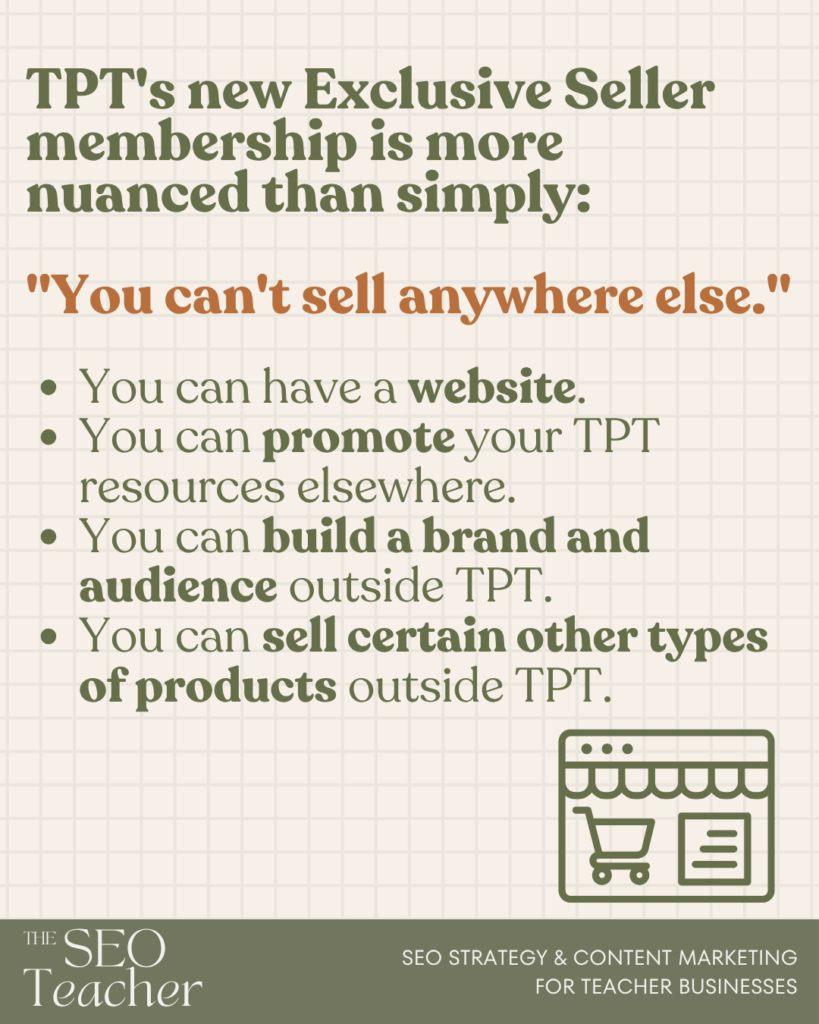
TPT’s new Exclusive Seller membership is more nuanced than simply:
“You can’t sell anywhere else.”
You can have a website.
You can promote your TPT resources elsewhere.
You can build a brand and audience outside TPT.
You can sell certain other types of products outside TPT.
But if you’re an Exclusive Seller, your qualifying digital educational resources need to remain exclusive to TPT.
That’s why I wouldn’t make this decision based solely on the higher payout.
Look at the business you’re building, what you want to sell, where you want to sell it and how much flexibility you want in the future.
TPT can be an important part of your business.
But it’s worth thinking about what you’re building around your TPT store as well.
Still unsure?
I’ve created a free worksheet to help you work through the decision by looking at each part of your business and thinking about where you’d like to take it in the future.
Looking for more ideas beyond TPT?
I’ve also created a free guide – Beyond TPT. The workbook explores all the areas mentioned in this article to help you expand and grow your business in a way that suits you.