If you sell on Teachers Pay Teachers, you’ve probably seen the announcement.
TPT has changed its seller membership structure, and from October 1, 2026, there are now two seller options: Basic Seller and Exclusive Seller.
For many sellers, the biggest concern is obvious: the new Exclusive Seller membership comes with a slightly lower payout than the old Premium membership, while also requiring sellers to sell their digital educational resources exclusively through TPT.
That has understandably led to a lot of questions.
Should I stay Exclusive? Should I switch to Basic? Should I start selling somewhere else? What does this mean for my website?
There isn’t one answer that is right for every seller.
Before you make a decision, it is worth stepping back and looking at what each option actually means — and, more importantly, what you want your business to look like.
First: What has actually changed?
As of October 1, 2026, TPT has retired the Premium Seller membership for new sign-ups and introduced two seller options:
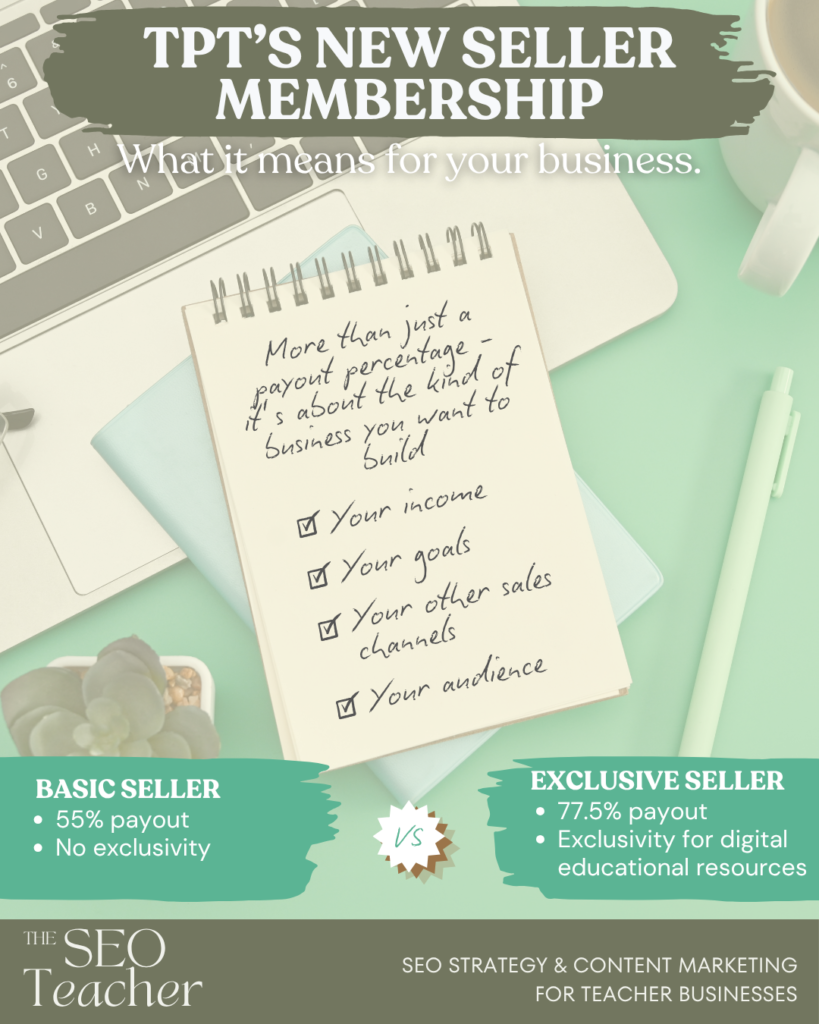
Basic Seller
- $29 USD one-time, non-refundable membership fee
- 55% payout on sales
- $0.30 transaction fee per resource
- No exclusivity requirement
Exclusive Seller
- $59.95 USD per year
- 77.5% payout on sales
- $0.15 transaction fee on orders under $3
- No transaction fee on orders over $3
- Access to additional seller tools and marketing features
- Digital educational resources must be sold exclusively through TPT
There is also a temporary 80% introductory payout for qualifying sellers who sign up as Exclusive between October 1 and December 31, 2026. The payout changes to 77.5% from January 1, 2027.
For existing Premium Sellers, the transition is slightly different.
If you currently have a Premium account, you can choose to become an Exclusive Seller from January 1, 2027.
If you don’t opt in, TPT says your account will automatically become a Basic Seller account on January 1, 2027. If you have time remaining on your Premium subscription, TPT says you’ll receive a prorated refund of $5 for each remaining month.
So yes — there is a real decision to make.
But I wouldn’t make it based on the headline numbers alone.
The bigger question is: What kind of business are you building?
It’s easy to look at:
80% → 77.5%
and think, That’s worse. I’m out.
Or to look at:
55% → 77.5%
and think, Obviously I should choose Exclusive.
But the percentage isn’t the whole story.
The more useful question is:
What role do you want TPT to play in your business?
For some sellers, TPT is essentially their entire business.
They have hundreds of products, a large customer base, strong sales and years of momentum on the platform. They don’t currently sell their educational resources anywhere else, and they are comfortable continuing to make TPT their main — or only — marketplace.
For those sellers, Exclusive may make sense.
For other sellers, TPT is one part of a much bigger business.
They may already have an Etsy store, their own website, a membership, another digital marketplace, a growing email list or plans to sell their resources through multiple channels.
For those sellers, the ability to sell educational resources elsewhere may be much more important than receiving the higher TPT payout.
Neither approach is automatically better.
They’re different business models.
What does “Exclusive” actually mean?
This is one area where I think it is worth slowing down, because some of the discussion around the announcement has made the changes sound broader than they actually are.
Being an Exclusive Seller does not mean you can’t have your own website.
It does not mean you can’t have an Instagram account, Facebook page, Pinterest account, blog or email list.
You can still promote your TPT store and resources elsewhere.
You can also maintain your own website or storefront.
The important part is where the transaction happens.
If you’re an Exclusive Seller, your qualifying digital educational resources need to be sold through TPT. If your website features one of those resources, the purchase needs to be routed back to TPT rather than processed through your own checkout.
You can still use your website to:
- build your brand
- share your teaching expertise
- write blog content
- attract Google traffic
- collect email subscribers
- share free resources
- promote your TPT products
- send visitors to your TPT listings
That’s an important distinction.
Your website can still be an asset even if TPT processes the final purchase.
What about selling elsewhere?
This is where the Basic and Exclusive options become much more different.
Basic Sellers are not subject to TPT’s exclusivity requirement, so they can sell their educational resources outside TPT, subject to TPT’s other seller guidelines.
Exclusive Sellers agree to sell their digital educational resources exclusively through TPT.
There are some exceptions for other types of products. TPT states that Exclusive Sellers can, for example, sell physical products, courses/professional development, clip art and fonts outside TPT. However, digital educational resources, memberships that include access to those resources and digital educational resource licences cannot be sold elsewhere under the Exclusive arrangement.
If you’re considering selling on multiple platforms, make sure you look at the current TPT rules rather than relying on what another seller says they are doing.
The rules around linking, pricing and directing buyers between platforms also still matter.
Don’t make your decision based on the payout percentage alone
This is probably the biggest piece of advice I’d give sellers right now.
Don’t simply calculate:
“TPT is taking X%, therefore I should leave.”
Instead, look at your actual numbers.
Ask yourself:
How much are you currently earning from TPT?
Look at your average monthly sales rather than focusing on your best month.
Then consider what the difference between the payout rates would actually mean for you in dollars.
A change that feels significant as a percentage may have a very different impact depending on whether you’re earning $300 a month or $5,000 a month.
How dependent are you on TPT?
If TPT disappeared tomorrow, what would happen to your business?
Would you have:
- another store?
- your own website?
- an email list?
- customers who know your brand outside TPT?
- another source of traffic?
- another way to sell your products?
Or would almost everything disappear with your TPT account?
There is no shame in being heavily reliant on TPT.
But it is useful to know that you are.
Do you actually want to sell elsewhere?
This is an important one.
You don’t need to build an Etsy store, your own website and five other sales channels simply because you can.
Selling on multiple platforms takes time.
Each platform has its own rules, product listings, customer expectations, fees and marketing requirements.
If you don’t actually want to manage another store, moving away from Exclusive purely because you’re worried about the principle of exclusivity may not make business sense.
On the other hand, if you’ve already wanted to build your own website or expand into other channels, this change may be a good reason to finally start.
Your website can be valuable even if TPT remains your checkout
One thing I don’t want sellers to overlook is the value of owning the place where people discover you.
You don’t own TPT.
You don’t control its algorithm.
You don’t control its search results, policies, membership structure or future changes.
But you can build assets that sit outside the marketplace.
Your website can become the place where teachers learn about you.
Your blog can bring in Google traffic.
Your free resources can introduce teachers to your work.
Your email list can give you a direct way to communicate with people who have chosen to hear from you.
Your social media accounts can help people recognise your brand.
And your TPT store can still be an important part of that system.
Think of it less as:
TPT OR my own website
and more as:
My business → my website/content/audience → TPT where appropriate
For an Exclusive Seller, the final purchase of an eligible educational resource may still happen on TPT.
But the relationship with the potential buyer doesn’t have to begin there.
You don’t have to rebuild your entire business overnight
If this announcement has made you realise that you’re too dependent on TPT, you don’t need to panic and try to move 300 products to another platform next week.
In fact, I wouldn’t recommend it.
Start smaller.
Build the foundations first.
Step 1: Know your numbers
Work out how much of your income currently comes from TPT.
Look at your best-selling products, your traffic sources and your strongest product categories.
Step 2: Build your own online home
If you don’t already have a website, you can start small.
You don’t need a huge website with hundreds of products.
A simple site with your brand, information about what you create, some useful content and a way for teachers to stay connected with you is a start.
Step 3: Start building an email list
Your TPT followers are valuable, but they are part of the TPT platform.
An email subscriber has chosen to hear from your business.
That gives you another way to stay connected with teachers over time.
Step 4: Build traffic you control more directly
This could come from Google.
It could come from Pinterest.
It could come from Instagram.
It could come from Facebook.
It could come from your email list.
It doesn’t have to be all of them.
Choose one or two that make sense for you and build them consistently.
Step 5: Decide what you actually want to sell elsewhere
You may decide that you don’t want to sell your educational resources anywhere else.
That’s fine.
You may decide you want to build a separate product line, such as physical products, clip art, fonts or professional development.
You may decide you eventually want to sell your educational resources through your own website or another marketplace.
That’s also fine.
The important thing is to make the decision based on your business, rather than reacting to someone else’s.
So… should you choose Basic or Exclusive?
I can’t tell you which one you should choose without knowing your business.
But I would ask yourself these questions:
1. How much of my income currently comes from TPT?
2. Am I already selling educational resources somewhere else?
3. Do I genuinely want to sell my educational resources on multiple platforms?
4. Do I have — or want to build — my own website?
5. Do I have an email list that I can communicate with directly?
6. How much would the difference in payout actually mean in dollars for my business?
7. Am I comfortable making TPT the exclusive marketplace for my educational resources?
8. Do I value the additional tools and features that come with Exclusive?
9. How much time would maintaining additional sales channels realistically take me?
10. What do I want my business to look like in three years?
That last question might be the most useful one.
Because this decision isn’t only about TPT’s membership structure.
It’s an opportunity to think about your business more broadly.
You don’t have to choose between “TPT seller” and “independent business owner”
You can be both.
TPT can be an incredibly useful marketplace for getting your resources in front of teachers.
At the same time, there is value in building things that exist outside any one platform.
Your brand.
Your website.
Your content.
Your email list.
Your audience.
Your knowledge of what your customers actually need.
Those things don’t become irrelevant because TPT changes its seller memberships.
If anything, the announcement is a useful reminder that building a business and building a TPT store aren’t necessarily the same thing.
Your TPT store can be one part of your business.
It doesn’t have to be the entire business.
And if you’re feeling overwhelmed by the changes right now, you don’t need to make every decision today.
Read the official information.
Look at your own numbers.
Work out what you actually want.
Then make the decision that fits your business, rather than following the loudest reaction online.
TPT has changed its options. That doesn’t mean you have to panic. It means it’s worth taking a closer look at the business you’ve built — and the business you want to build next.
This post is based on TPT’s current seller membership information published in October 2026. TPT has announced a Town Hall for October 8, 2026, and some details may be clarified as the transition progresses. Always check TPT’s current seller terms and guidelines before making a membership or platform decision.