TPT sellers often ask:
What keywords should I put in my title?
It’s a reasonable question.
But I think there’s a better one:
Can a teacher quickly understand what this resource is and whether it’s relevant to them?
Because your TPT title has two important jobs:
- Help the right buyers find your resource.
- Help them understand what they’re looking at.
If a teacher sees your product in search results and can’t quickly work out what it is, who it’s for or why they might need it, they may scroll past — even if your resource is exactly what they were looking for.
So let’s look at what makes a strong TPT title.
A good title is clear before it’s clever
Teachers are busy.
They’re often searching for something specific:
- a lesson for a particular topic
- a resource for a particular grade
- an activity for a specific skill
- something they can use quickly
Your title should help them answer:
“Is this what I need?”
as quickly as possible.
That doesn’t mean your titles need to be boring. But clarity is usually more useful than creativity.
For example:
Less clear:
Amazing Classroom Activities
Clearer:
3rd Grade Reading Comprehension Activities | Printable Passages
The second title tells the buyer much more:
- grade level
- subject area
- resource type
The teacher doesn’t have to guess.
What information belongs in a title?
Not every title needs the same ingredients, but these are some things worth considering.
The topic or skill
What is the resource actually about?
Examples:
- fractions
- persuasive writing
- classroom procedures
- multiplication
- animal adaptations
This is often the most important part.
The resource type
What is the buyer getting?
Examples:
- lesson plans
- task cards
- worksheets
- centres
- posters
- activities
- sub plans
- bulletin board
This helps teachers quickly understand the format.
The audience or grade level
This isn’t necessary for every product, but it can be useful when it genuinely matters.
Examples:
- Kindergarten
- Grades 3–4
- Middle School
- High School
A teacher wants to know:
“Will this work for my students?”
If the answer isn’t obvious, your title may be able to help.
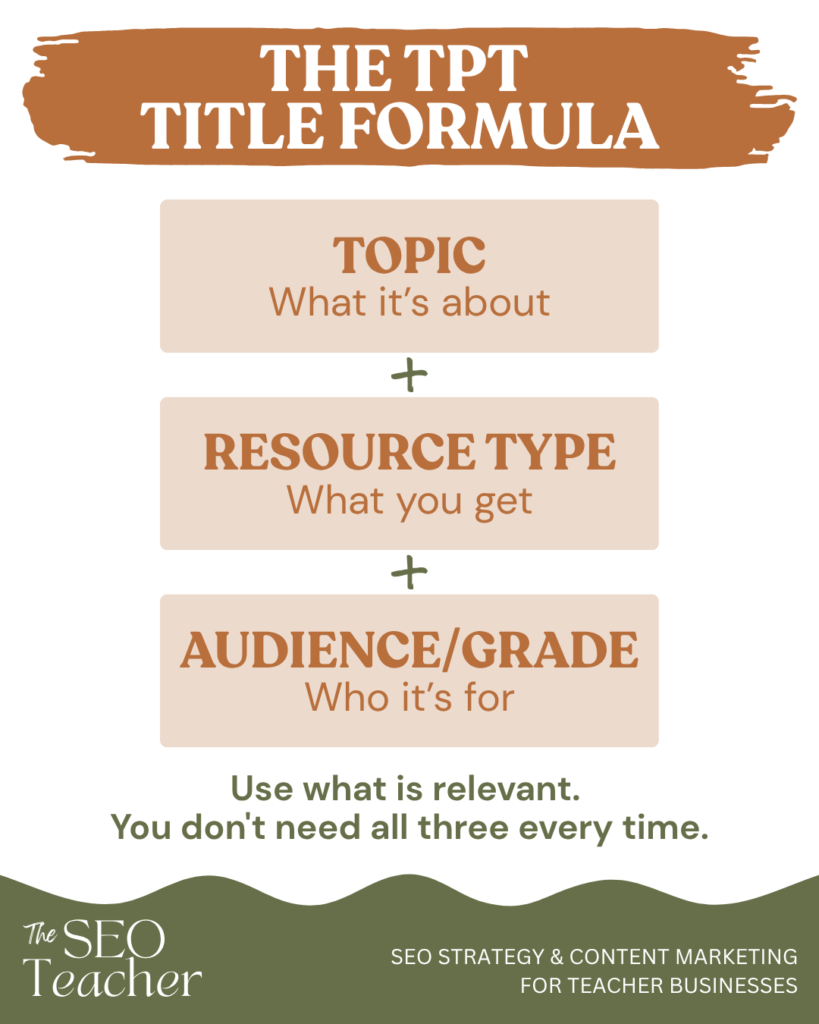
A simple title formula
You don’t need to follow a strict template, but this can be helpful:
Topic + Resource Type + Audience
For example:
Fractions Task Cards | 4th Grade Maths Activities
Or:
Classroom Jobs Display | Editable Classroom Decor
Or:
Persuasive Writing Lesson Plans | Upper Primary
You don’t need every element every time.
But thinking through these categories can help you create clearer titles.
More keywords don’t automatically make a better title
This is one of the biggest misconceptions about TPT SEO. Sometimes sellers try to include every possible search term. The result can become long, repetitive or difficult to read.
For example:
Reading Activities Reading Worksheets Reading Comprehension Literacy Reading Centers Printable Reading Resource
Technically, that contains a lot of words. But does it help a buyer understand the product? Probably not. A clear title is often more useful than a title trying to include every possible keyword.
Your goal isn’t:
“How many search terms can I fit in?”
Your goal is:
“How clearly can I describe this product?”
Use words buyers actually use
That doesn’t mean stuffing keywords into titles. It means thinking about how teachers naturally describe resources.
If teachers search for:
- reading comprehension
- maths centres
- classroom jobs
- writing prompts
and those phrases genuinely describe your resource, it makes sense to use that language.
But if a term doesn’t accurately describe the product, don’t add it just because it seems popular. Relevance matters more than search volume.
Avoid titles that are too broad
Sometimes a title is technically correct, but so broad that it doesn’t tell the buyer enough.
For example:
Science Activities
That could mean almost anything.
Compare that with:
States of Matter Activities | Printable Science Worksheets
The second title gives the buyer much more information. Specific titles often help the right buyers find the right products.
Don’t make buyers work too hard
Imagine a teacher sees your product in search results.
They have a few seconds to decide:
Click or keep scrolling?
If they need to open the listing and read half the description before understanding what the product is, your title may not be doing enough work.
Try this simple test:
Show your title to someone else.
Ask:
What do you think this resource is?
Who is it for?
What would a teacher use it for?
If those answers aren’t reasonably clear, you may have an opportunity to improve the title.
When should you change a title?
Not every title needs changing.
If a product:
- gets good traffic
- converts well
- earns consistently
there may be no reason to make major changes.
SEO doesn’t mean changing everything. Sometimes your data tells you – this title is already working. And that’s useful information too.
I think it’s easy to fall into the trap of changing listings simply because you’ve learned something new about SEO. But good SEO isn’t about making endless changes. It’s about making purposeful changes when the evidence gives you a reason.
Small changes can make a difference
You don’t need to rewrite your entire store.
Instead:
- choose a few products
- look at how they are performing
- review the title
- ask whether the title is clear
- decide whether a small improvement could help
Then record what you changed and give it time.
Over time, you’ll start to learn what types of wording and titles work best for your store. That’s much more valuable than trying to apply the same formula to hundreds of products.
Your title is often the first impression
Teachers don’t buy resources because the title contains lots of keywords.
They buy resources because they quickly understand:
- what the product is
- who it is for
- why it will help them
A good title helps the right buyers find your product.
A great title also helps them think:
“Yes — this is exactly what I need.”
And that’s the real goal.
Want help reviewing your TPT listings?
My TPT SEO & Growth Review looks at your search and product data to identify opportunities, review priority products and help you decide where small changes may make the biggest difference.