If you already write detailed product descriptions for your TPT resources, you might be wondering whether you really need a blog.
After all, you’re already describing what’s included, explaining how the resource works and highlighting its benefits.
While product descriptions are essential for selling your resources, they serve a very different purpose to blog posts. Understanding the difference can help you attract more teachers to your website and create content that works much harder for your business.
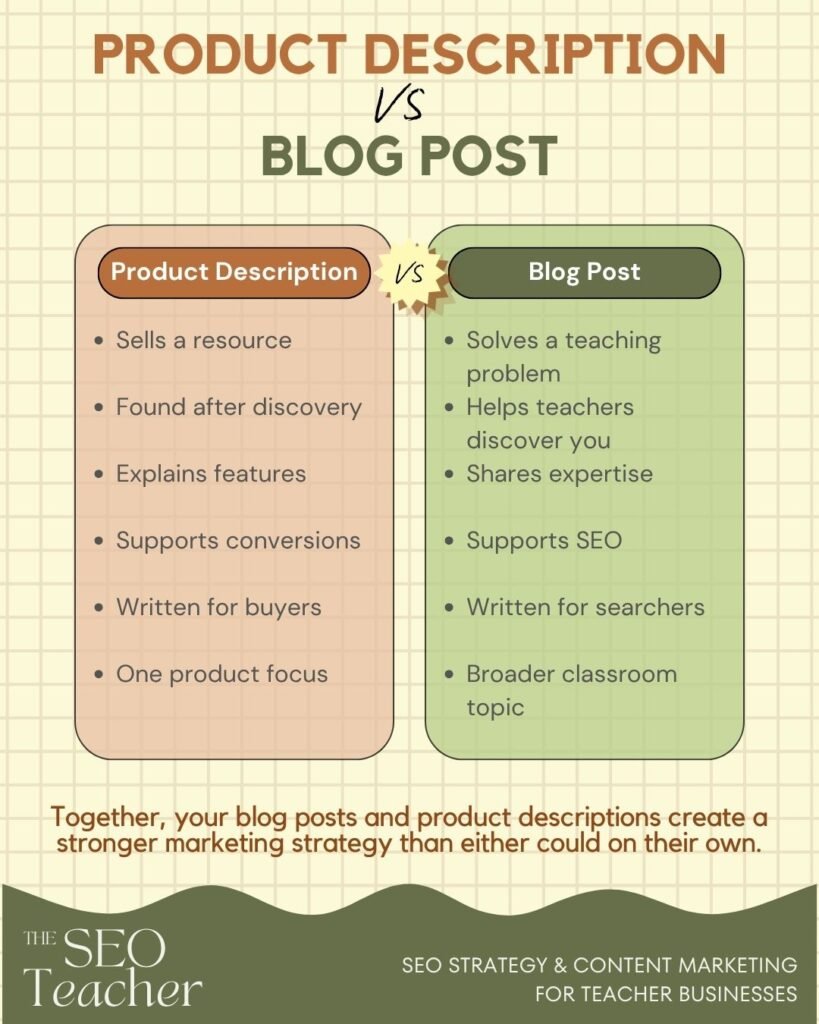
Product Descriptions Sell
A product description is written for a teacher who has already found your resource.
Its job is to answer questions like:
- What’s included?
- Which year levels is it suitable for?
- How can I use it in my classroom?
- Why should I choose this resource?
By the time a teacher is reading your product description, they’re already considering a purchase.
Product descriptions help convert visitors into customers.
Blog Posts Help Teachers Find You
A blog post has a different purpose.
Instead of selling a resource, it answers a question or solves a problem that teachers are already searching for.
For example, instead of writing about your Fractions Escape Room, you might write:
- How to Make Fractions More Engaging in Upper Primary
- Five Hands-On Fraction Activities Your Students Will Love
- Common Fraction Misconceptions (and How to Address Them)
Within that article, you can naturally recommend your Fractions Escape Room as one possible classroom solution.
The blog post attracts visitors.
Then, the product description helps them decide whether your resource is right for them.
Think About the Teacher’s Journey
Imagine a Year 5 teacher is planning next week’s maths lessons.
They probably aren’t searching for:
“Fractions Escape Room PDF”
They’re much more likely to search for:
- engaging fraction activities
- teaching equivalent fractions
- upper primary fraction games
- fraction lesson ideas
A helpful blog post can answer those questions.
Once the teacher trusts your advice, introducing your resource feels helpful—not salesy.
Both Have an Important Role
The strongest teacher business websites use both.
| Product Description | Blog Post |
| Explains one resource | Solves a teaching problem |
| Written for shoppers | Written for teachers searching online |
| Focuses on features and benefits | Focuses on advice, ideas and strategies |
| Encourages a purchase | Builds trust and attracts visitors |
| Lives on your product page | Lives in your blog or resources section |
Your product description closes the sale.
Your blog post starts the conversation.
One Resource, Two Types of Content
Imagine you’ve just published a Persuasive Writing Unit.
Your product description explains:
- what’s included
- curriculum links
- lesson sequence
- printing options
Your blog post could explore:
- How to Teach Persuasive Writing in Year 4
- Persuasive Writing Topics Students Actually Enjoy
- A Simple Persuasive Writing Lesson Plan
- Common Persuasive Writing Mistakes
Each article reaches teachers at an earlier stage of their search and naturally points them towards your resource.
The Best Teacher Business Websites Do Both
If your website only contains product descriptions, you’re missing an opportunity to connect with teachers before they’re ready to buy.
Blog posts allow you to:
- answer common teaching questions
- demonstrate your classroom expertise
- target keywords teachers are searching for
- build trust over time
- create multiple pathways to your TPT resources
Together, your blog posts and product descriptions create a stronger marketing strategy than either could on their own.
Final Thoughts
Product descriptions and blog posts aren’t competing with each other—they’re working together.
Think of it this way:
- Your product description helps teachers decide to buy.
- Your blog post helps teachers discover you in the first place.
When every new TPT resource is supported by both, you’re not just creating resources—you’re building a website that continues working for your business long after you’ve clicked “Publish.”
If you’re not sure whether your website is making the most of your content, The Growth Roadmap™ identifies opportunities to improve your SEO, strengthen your content strategy and help more teachers discover your resources through Google.
Learn more about