You’ve created an amazing resource.
You’ve spent hours designing activities, formatting pages, testing ideas in your classroom, and uploading your finished product to Teachers Pay Teachers.
But then comes the question every teacher business owner eventually asks:
How do teachers actually find my resources?
Many teacher authors assume the answer is simple:
Teachers search on TPT, find my product, and buy it.
And that does happen.
But it is only one part of the journey.
Many teachers discover resources long before they know exactly what they want to purchase. They are searching for ideas, solutions, and answers to classroom challenges — and this creates opportunities for teacher businesses with a strong website and content strategy.
Understanding how teachers search can help you create a stronger connection between your blog, your website, and your TPT resources.
The two ways teachers discover resources
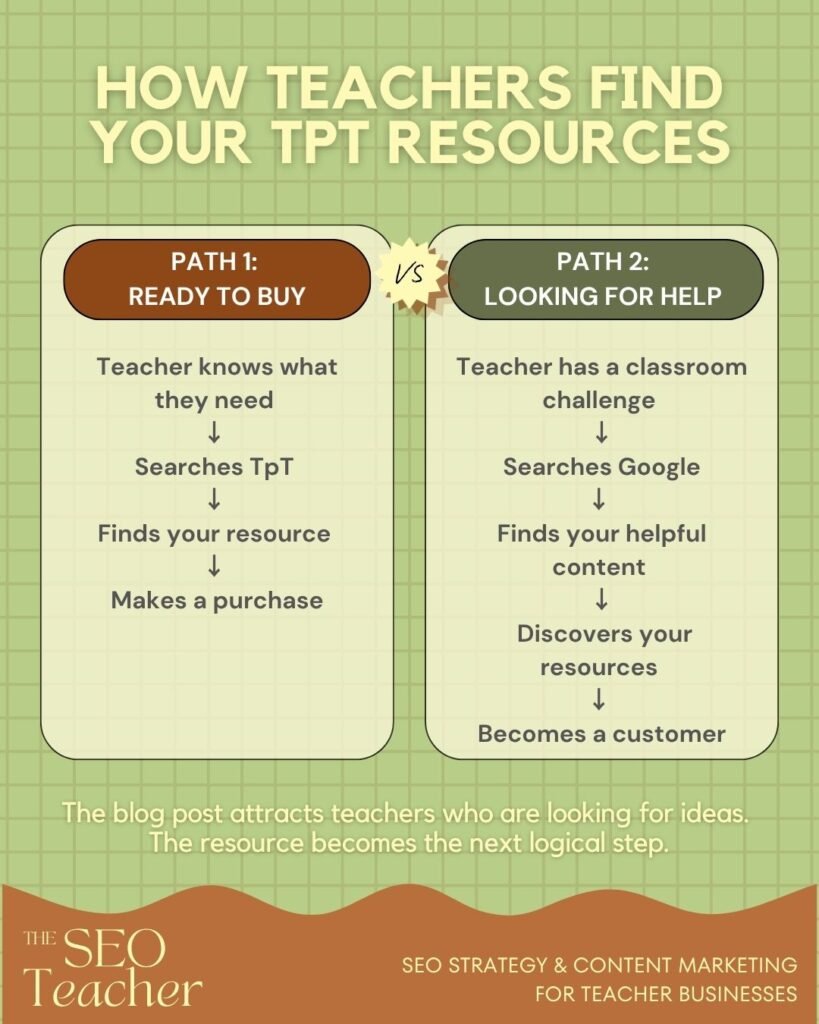
Teachers generally find resources in two main ways.
1. They search for a resource they already know they need
This is the traditional TPT search journey.
A teacher has a specific need:
- “kindergarten sight word activities”
- “place value worksheets”
- “reading comprehension passages”
- “back to school activities”
They head to Teachers Pay Teachers, type in their search, compare resources, look at reviews and previews, and decide what to purchase.
This is valuable traffic because the teacher already has buying intent.
However, there is one challenge:
You are competing with hundreds (or sometimes thousands) of other resources targeting similar searches.
Your:
- product title,
- cover image,
- previews,
- reviews,
- keywords,
- and TPT optimisation
all influence whether your resource gets noticed.
But there is another opportunity that many teacher authors overlook.
2. They search for help before they know what resource they need
Many teachers do not begin their search knowing the exact resource they want.
They begin with a question, a challenge, or a goal.
They might search:
- “how to teach letter recognition in kindergarten”
- “fun ways to practise multiplication facts”
- “first week of school activities”
- “how to teach narrative writing”
- “phonics activities for struggling readers”
At this stage, they are not necessarily looking to buy.
They are looking for ideas.
They may find:
- a blog post,
- a teaching strategy,
- a classroom activity,
- a Pinterest pin,
- a helpful resource recommendation.
If your website helps answer their question, they can discover your business before they ever search on TPT.
This is where SEO and strategic blog content can help teacher businesses reach teachers earlier in their journey.
Product descriptions help buyers. Blog posts help discoverers.
Your TPT product description has an important job.
It answers:
“Why should I buy this resource?”
It explains:
- what is included,
- who the resource is for,
- how it can be used,
- what problem it solves.
A blog post has a different purpose.
It answers:
“How can I solve this teaching problem?”
For example:
A product listing might promote:
Christmas Math Activities for Kindergarten
A blog post could target:
15 Christmas Math Activities to Keep Kindergarten Students Engaged
The blog post attracts teachers who are looking for ideas.
The resource becomes the next logical step.
Your blog should not just become another product catalogue
One of the most common mistakes teacher businesses make is using their blog only to announce resources.
For example:
“My new Halloween craft bundle is now available!”
This may be useful for existing followers, but it is unlikely to attract many new teachers through Google.
Instead, think about the questions teachers are already searching.
A stronger blog strategy might include posts like:
- “10 Halloween Activities Kindergarten Students Will Love”
- “How to Teach Phonics Through Hands-On Activities”
- “Easy Ways to Practise Sight Words”
- “The Best End-of-Year Activities for Elementary Classrooms”
Within helpful content like this, your resources can become the solution.
Your existing resources are a content opportunity
One of the biggest advantages teacher authors have is that they already have hundreds of ideas sitting inside their TPT stores.
Every resource represents a potential content opportunity.
A single resource could inspire:
- a blog post,
- a Pinterest pin,
- an email newsletter,
- an Instagram post,
- a classroom tips article.
For example – A beginning sounds resource could become:
Blog post:
“5 Fun Ways to Practise Beginning Sounds in Kindergarten”
Pinterest pin:
“Beginning Sounds Activities for Kindergarten”
Email newsletter:
“Easy Literacy Centre Ideas for Early Readers”
Your resource becomes part of a bigger discovery pathway.
The goal is not just more website visitors
SEO is not about attracting random visitors.
The goal is attracting the right teachers.
A teacher who discovers your website through a helpful article about a classroom challenge is already interested in your area of expertise.
They may then:
- explore your resources,
- join your email list,
- follow your business,
- purchase a resource.
You have created a relationship before the sale.
Your TPT store and website should work together
Teachers Pay Teachers is a powerful marketplace, but your website gives you something you do not own on a marketplace:
A place to build your own audience.
The strongest teacher businesses often create a connection between:
Helpful content → Website visitor → Resource discovery → Purchase
Your resources solve classroom problems.
Your blog helps teachers discover those solutions.
When both work together, your website becomes more than a place to display your products. It becomes a tool for attracting teachers who are actively looking for what you create.
Ready to discover your biggest SEO opportunities?
The Growth Roadmap™ is a personalised SEO strategy designed specifically for teacher businesses.
It identifies opportunities across your website, blog, and resources, then provides a practical action plan to help more teachers discover your work through Google.
Learn more about