
If you’re a TPT seller, you might have wondered whether you actually need your own website.
After all, you already have a TPT store. Teachers can find your resources there, TPT handles the checkout, and your products are already sitting on a marketplace where teachers are actively searching.
So what’s the point of having a separate website?
Especially now, with TPT’s new Basic and Exclusive Seller memberships, it’s a question worth thinking about.
But I don’t think the answer is that your website needs to become a second version of your TPT store.
Your website has a different job.
It gives your business somewhere to exist outside the marketplace.
And you don’t need a huge, complicated website to make that useful.
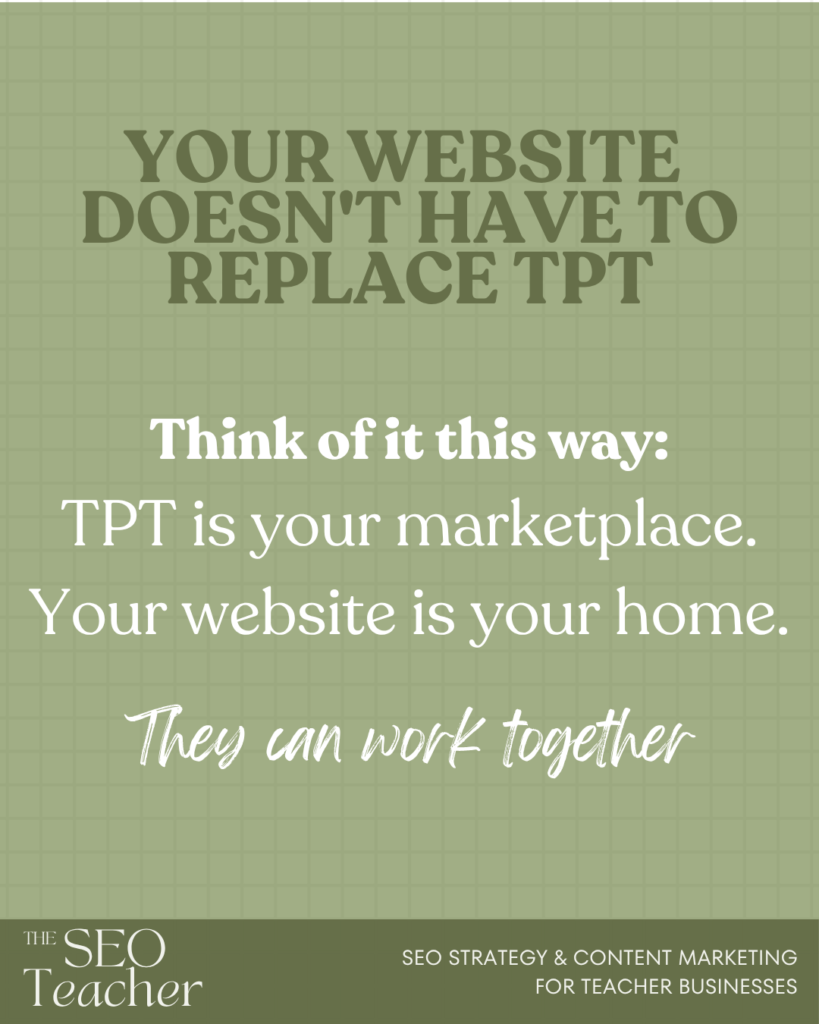
Your website doesn’t have to replace TPT
Let’s get this out of the way first.
Having a website doesn’t necessarily mean setting up your own online store and moving your TPT resources somewhere else.
In fact, if you’re an Exclusive Seller, qualifying digital educational resources still need to be sold through TPT.
Your website can instead act as the home base for your business, while TPT remains the place where customers purchase your qualifying digital resources.
Think of it this way:
TPT is your marketplace.
Your website is your home.
They can work together.
Your website can help people discover who you are, understand what you offer, find your resources and connect with you. Then, when they’re ready to buy a qualifying TPT resource, you can send them to your TPT store.
So what should actually go on your website?
If I were putting together a simple website for a TPT seller, I’d start with six things:
- A clear homepage
- An About page
- A way to find your TPT resources
- Free resources
- A blog
- An email signup
You can add more as your business grows.
You don’t need all the bells and whistles on day one.
Let’s look at what each part can actually do for you.
1. Your homepage
Your homepage doesn’t need to be complicated.
Its main job is to answer three questions quickly:
Who are you?
What do you create?
Why should a teacher care?
For example, if you create middle school science resources, your homepage might explain that you create ready-to-use science lessons and activities for middle school teachers.
You could then direct visitors towards:
- Your TPT store
- Your most popular resources
- Your free resources
- Your blog
- Your email list
The important thing is that a visitor shouldn’t have to figure out what your business is about.
Your TPT store already has a product catalogue.
Your website should help people understand the business and brand behind that catalogue.
2. Your About page
An About page can do more than tell people how long you’ve been teaching.
Think about what a potential customer might want to know before deciding to trust your resources.
You could include:
- Your teaching background
- Your subject or grade-level expertise
- Why you started creating resources
- The type of teacher you create for
- What makes your resources different
- Your teaching philosophy or approach
You don’t need to write your entire life story.
The goal is to help the right people think:
“This person understands teachers like me.”
That’s useful whether someone finds you through TPT, Google, Pinterest, social media or a recommendation from another teacher.
3. A way to find your TPT resources
This is where I see TPT sellers sometimes overcomplicating things.
You don’t necessarily need to recreate your entire TPT catalogue on your website.
Instead, think about how you can make it easier for visitors to find the resources that are most relevant to them.
You might organise them by:
- Grade level
- Subject
- Topic
- Resource type
- Seasonal need
- Popular resources
You could have sections such as:
Popular Resources
Science Resources
Back-to-School Resources
Free Resources
Each resource can then link through to the relevant TPT listing.
This is particularly useful if someone discovers you through your website rather than through TPT.
Instead of landing on your homepage and thinking, “Okay, but where are the resources?”, they have a clear path to your TPT store.
4. Free resources
This is one of the biggest opportunities your website gives you.
Your TPT store is primarily designed around selling resources.
Your website can give people a reason to connect with you before they’re ready to buy.
That could be:
- A teacher checklist
- A mini activity
- A planning template
- A classroom resource
- A guide
- A short ebook
- A printable
- A helpful reference sheet
You can offer the free resource in exchange for an email address if you’re building an email list.
And this creates a relationship that doesn’t depend entirely on someone remembering to come back to your TPT store.
For example:
A teacher finds your blog through Google.
↓
They read a useful article.
↓
You offer them a related free resource.
↓
They join your email list.
↓
You can continue providing useful content and let them know about new resources.
That’s very different from relying on a teacher to stumble across your TPT store again.
5. Your blog
This is where your website can do something your TPT store can’t do as easily:
help people discover you through Google.
Teachers don’t always start their search on TPT.
They might search Google for:
- “how to teach fractions to fourth graders”
- “first day activities for middle school”
- “fun ways to teach the water cycle”
- “emergency sub plans for elementary”
- “persuasive writing activities”
- “Christmas classroom activities”
Those searches represent problems and questions.
And some of those teachers may eventually want a resource to help solve that problem.
Your blog gives you somewhere to answer the question first.
A useful blog post can then naturally point readers towards:
- A relevant TPT resource
- A free resource
- Your email list
- Another helpful article
This is one of the biggest reasons I think a website can be valuable for a TPT seller.
Your TPT listings can help you be found by people searching on TPT.
Your website can help you be found by people searching on Google.
Those are two different discovery opportunities.
6. Your email list
Your website can also give you something your TPT store can’t give you in quite the same way: a place to build an audience you can communicate with directly.
A teacher who buys one of your resources on TPT might never see your next product.
A teacher who joins your email list has chosen to hear from you again.
You can use your website to invite people to join your list through:
- Free resources
- Blog posts
- Resource pages
- Your homepage
- Special offers or launches
- Helpful teacher content
And you don’t need to start with a complicated email marketing strategy.
Even a simple:
Get new resources, helpful teaching ideas and free resources in your inbox.
can be a starting point.
What you probably DON’T need
This is just as important.
When I talk to teacher-sellers about websites, I don’t want you to come away thinking you need to build another enormous project for yourself.
You probably don’t need:
- Hundreds of product pages
- A complicated online shop
- A huge blog with dozens of categories
- A membership site
- Five different lead magnets
- A dozen pages of sales copy
- A completely custom website
- A daily content schedule
You need a website that does a few things well.
Help people understand who you are.
Help them find your resources.
Give them useful information.
Give them a way to stay connected with you.
That’s enough to start.
What if I’m an Exclusive Seller?
This is where the new TPT membership structure makes the conversation particularly interesting.
TPT’s current rules allow Exclusive Sellers to maintain their own website or storefront and promote their TPT resources elsewhere.
The important restriction is that qualifying digital educational resources must be sold exclusively through TPT.
So your website doesn’t have to disappear if you choose Exclusive.
You can still use it to:
- Build your brand
- Publish content
- Attract visitors from Google
- Offer free resources
- Build your email list
- Promote your TPT store
- Sell permitted products and services
Your website simply isn’t the place where you directly sell your qualifying TPT digital educational resources.
That distinction is worth understanding before you decide what role you want your website to play.
Your website doesn’t need to be another TPT
This is probably the biggest mistake I’d avoid.
You don’t need to look at your TPT store and think:
“Now I have to build all of that again on my own website.”
You don’t.
Your TPT store already does the marketplace job.
Your website can do something different.
It can become the place where someone learns:
Who you are.
What you know.
What you create.
Who you help.
What else you offer.
And, importantly, how to find you again.
If I were starting a TPT seller website today…
I’d keep it simple.
Homepage
Who you are, what you create and where visitors should go next.
About
Your experience, expertise and story.
Resources
A curated way to find your TPT resources.
Free Resources
Useful downloads that give people a reason to connect with you.
Blog
Helpful content that answers the questions teachers are already searching for.
Email Signup
A simple way to stay in touch with people who want to hear from you.
That’s it.
You can add other things later when your business actually needs them.
Your TPT store can be part of your business without being your entire business
I think this is the bigger opportunity behind all the current TPT membership discussion.
You don’t have to choose between:
“I’m a TPT seller.”
and
“I have my own business.”
You can be both.
Your TPT store can remain an important sales channel while your website, content, email list, brand and audience grow around it.
And that’s valuable regardless of whether you eventually choose Basic or Exclusive.
Because the more of your business you build outside the marketplace itself, the less you are relying on one platform to provide every part of the customer journey.
Your website doesn’t have to replace TPT.
It just needs to give your business somewhere else to exist.
Want to start building beyond your TPT store?
I’ve put together a free guide for teacher-sellers who want to start building a business they have more control over.
Get the free Beyond TPT: A Teacher-Seller’s Guide to Building a Business You Control →